An Anthropologist at the UN Open Source Week
Sythong RunOn the fourth day of UN Open Source Week--in Economic and Social Council chamber, New York--Jim Zemlin, CEO of the Linux Foundation, told the room: "The open source community is actually a diaspora of hundreds of thousands of individuals and organizations that all make this rich tapestry."
I was, as far as I could tell, the only anthropologist in the room. In my experience, people are often a little surprised to find an anthropologist at a software-related conference; it doesn't sound like their natural habitat. They’re supposed to be off studying distant villages or digging up cultural artifacts, not sitting in on talks about software. But a diaspora, a tapestry--those aren't engineering words. They're words about people, and that is exactly why I was there.
Anthropologists study human experience wherever it happens. Open source software offers a remarkable example: hundreds of thousands of people collaborating across borders, culture, and time zone, to mention a few, to produce code that anyone can read, use, modify, and share.
We rely on open source constantly, often without noticing. More and more of our lives are mediated by the Internet--something most of us take for granted, but which, as the anthropologist Chris Kelty puts it, means many specific things to many specific people (2008, 4). Much of what makes the Internet work is open source software. The padlock icon on your browser that signals a secure connection, for instance, relies on it.
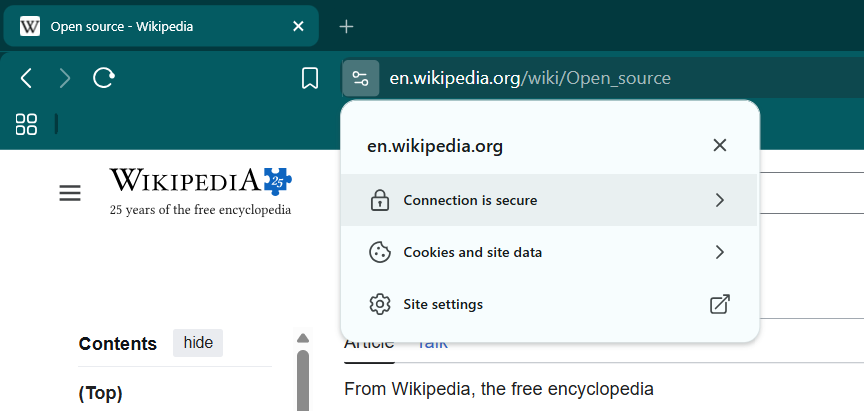
Open source extends well beyond the web, often serves as non-differentiating technology, the features that don't set competing products apart, so companies have little incentive to build it separately and every reason to share the work. That's why you find open source software even in everyday technology like cars. In this post I want to share why this community pulls at me, what the Open Source Week left me thinking about, and where my research interest lies.
My Interest in Open Source
It began with a tattoo. In December 2024 I was taking Python for Everybody (Py4E), a free online course by Charles Severance--"Dr. Chuck," a clinical professor of information at the University of Michigan--who has a gift for explaining technical ideas to someone who's never taken a computer science class, like me. One day he talked about the logos inked on his shoulder; among them, the logo of Sakai, an open source learning platform he'd helped build (Severance 2017, 2:08-3:20). Open source geeks like to say they’re “standing on the shoulders of giants,” and here was a man with the giants inked onto his. The image struck me, and I began asking questions: what brings people like Dr. Chuck together? What makes someone volunteer their labor to build ethical tools, freely, for everyone?
The more I learned about open source, the more I kept dwelling on political consumerism--the way activism has turned everyday purchases, from coffee to clothing, into sites where consumers feel a global obligation to act responsibly. Consumers learn to express their values, affirm who they are, and stake out their commitments through purchases; buying fair-trade items is supposed to say something about the kind of person you are. But consumption is only one way of performing liberal selfhood, and open source struck me another--one that runs the opposite direction. Where political consumerism is about what you buy, open source is about what you make; where one is individual, the other is collective. For over four decades, free and open source participants have made their politics through code--choosing free software over proprietary, donating their labor to shared projects, building infrastructure that lives outside any company's control. (There are more nuance to this, but that will have to be a separate post.)
For a while this frustrated me. Boycotts and buycotts of tangible products have broken into public consciousness--people know to ask where products come from, to seek out ethical businesses--but software has never quite become that kind of cause. I used to corner anyone who would spare me the time and make the case for open source. The more I thought about it, however, the less I wanted to be a prophet for ethical software consumption. What I want instead is to point at the invisible labor that keeps the Internet running and powers the domains that depend on it: the unglamorous, mostly unpaid work of maintaining the software we never think about.
What Stuck With Me
I carried this interest in maintainer and community dynamics with me to the conference, where I made a point of sitting in on the maintain-a-thon breakout sessions and the panels on community and the global impact of open source. Two themes from the week have stayed with me since.
One of the ideas that lingers with me was the contrast between how open source is talked about how it is actually supported. Throughout the conference, it was celebrated as a strategic asset, for digital sovereignty, digital public infrastructure, digital public goods, and scientific collaboration. But beneath that broad agreement sat an uncomfortable question: if open source is public infrastructures, who is actually sustaining it? There is still no clear understanding of how governments and public institutions contribute to the ecosystem. The discussions also underscored that recognition is not the same as investment. Governments may increasingly depend on open source, yet that dependence does not automatically support the maintainers and communities whose often invisible work keeps it running. Time and again, the conversation returned to funding, not whether open source matters, but how the labor behind it can be sustained.
Another theme was where the attention of the conversation was placed: not on software, but on the communities that produce it. The talk came back again and again to maintainer burnout, to making projects more welcoming and inclusive for new contributors--particularly those from underrepresented groups--and to the social structures that keep people involved over time. The underlying message was that the long-term health of open source depends less on maximizing technical contributions than on cultivating communities that are resilient enough to support the people doing the work.
My Research Interests
The two themes that stayed with me converge on a single point: the future of open source depends less on the code than on the people who sustain it, and on whether the communities they build can sustain them in return. This brings me to the question I keep coming back to: as open source becomes increasingly indispensable yet unevenly supported, how do the distributed communities that produce it sustain not only their software but also the people behind it? More specifically, how is that work mediated through the community guidelines, governance documents, and informal norms that shape participation?
Community guidelines are easy to dismiss as administrative detail. Yet they are also where communities make their values explicit, articulate expectations, and define the conditions of belonging. Their existence feels especially significant when questions of diversity and inclusion have become increasingly contentious. Last year, for example, the Python Software Foundation withdrew from a $1.5 million grant proposal to the U.S. National Science Foundation after learning that new grant conditions conflicted with the Foundation's commitment to diversity, equity, and inclusion (Python Software Foundation, 2025). Episodes like this reveal that community values are not just aspirational statements; they can carry material consequences for how projects are funded and governed. Because open source is sustained by the people who maintain it, these seemingly mundane documents are themselves part of its infrastructure. The invisible work they organize deserves to be taken as seriously as the code they help produce.
That question of community sustainability also frames the second problem I keep returning to. I was first drawn to open source by the ethic of "standing on the shoulders of giants," the idea that software advances through visible chains of learning, attribution, and shared contribution. Generative AI places that ethic under new strain by changing not only how software is written but what it means to contribute in the first place. Recently, the Software Freedom Conservancy published recommendations for the use of LLM-backed Generative AI systems in free software contributions. What is striking about those recommendations is that they are less concerned with the quality of AI-generated code than with preserving the social conditions of open source itself.
The recommendation that contributors disclose how and when they use AI, and even save their prompts and logs, reads as an effort to preserve transparency and attribution in software development. At the same time, the guidance emphasizes that maintainers should hold final authority over their projects while treating contributors with respect; likewise, contributors should treat maintainers with respect. The central question is how open source communities renegotiate long-standing norms of authorship, expertise, transparency, and participation when software can increasingly be produced with less direct human effort.
Together, these questions point toward the same broader concern. If open source succeeds not because code is freely available but because communities continually reproduce the knowledge, trust, and relationships that make collaborative software development possible, then understanding how those communities adapt, to political change, to funding pressures, and now to generative AI, has become as important as understanding the software they produce.
References
-
Chuck Severance. “PY4E - Regular Expressions (Chapter 11 Part 1)” YouTube, 16 Dec 2016,
https://www.youtube.com/watch?v=ovZsvN67Glc - Christopher M. Kelty Two Bits: The Cultural Significance of Free Software and the Internet Durham: Duke University Press, 2008.
-
Python Software Foundation. “The PSF Has Withdrawn a $1.5 Million Proposal to US Government Grant Program .” Python Software Foundation (blog), October 27, 2025.
https://pyfound.blogspot.com/2025/10/NSF-funding-statement.html. -
Software Freedom Conservancy. “LLM Backed Generative AI Recommendations - Software Freedom Conservancy.” Software Freedom Conservancy, June 2026.
https://sfconservancy.org/llm-gen-ai/llm-backed-generative-ai-recommendations.html